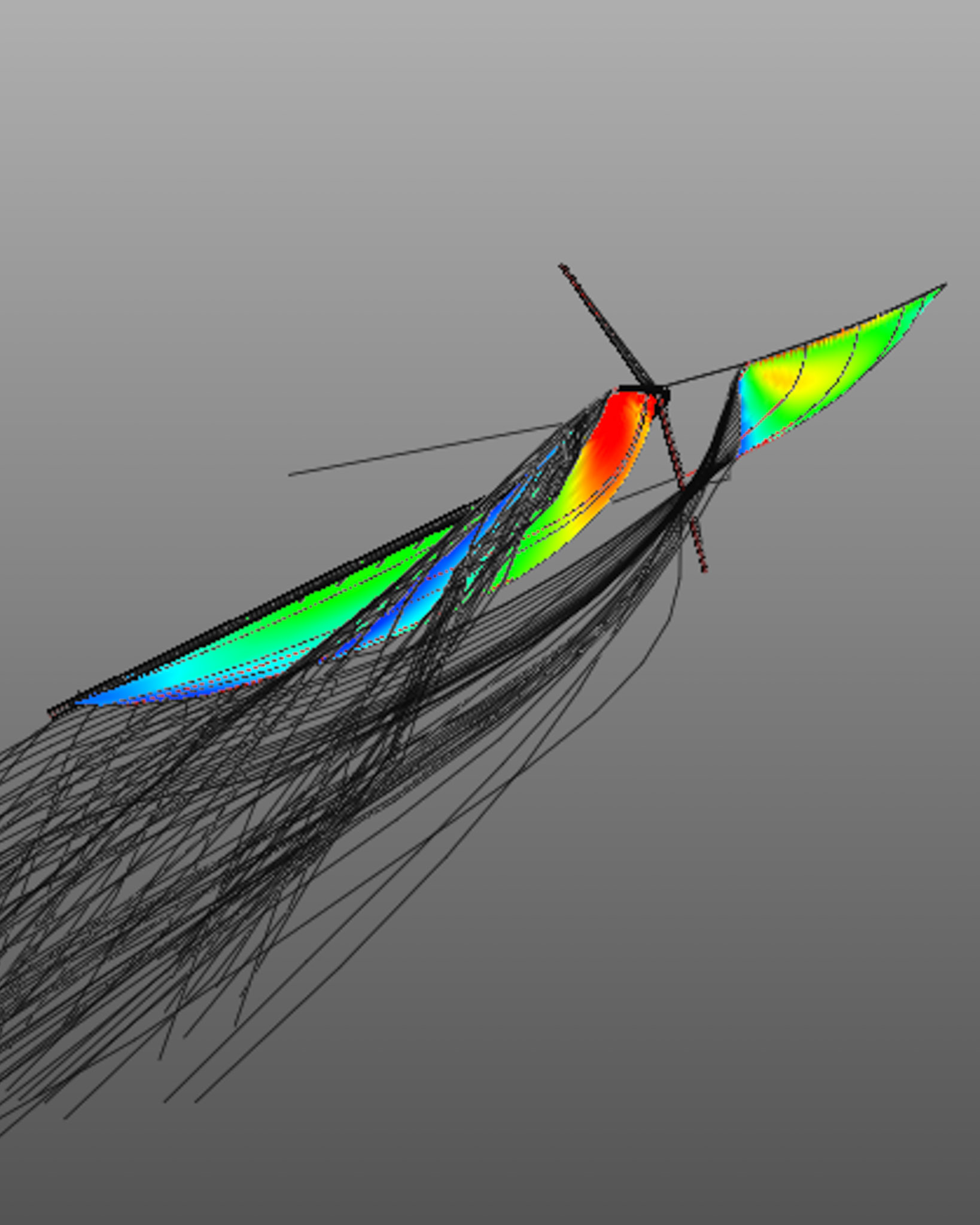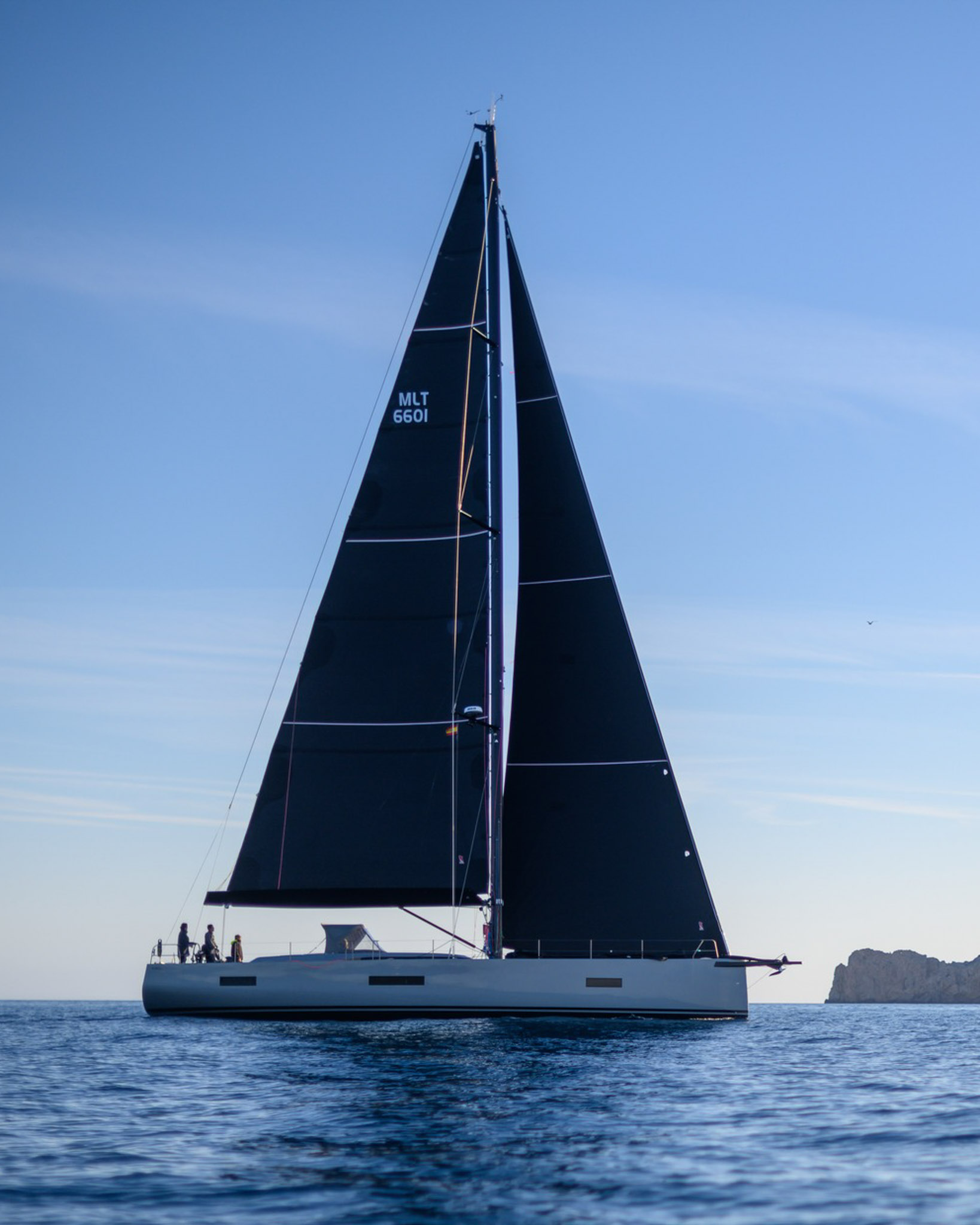


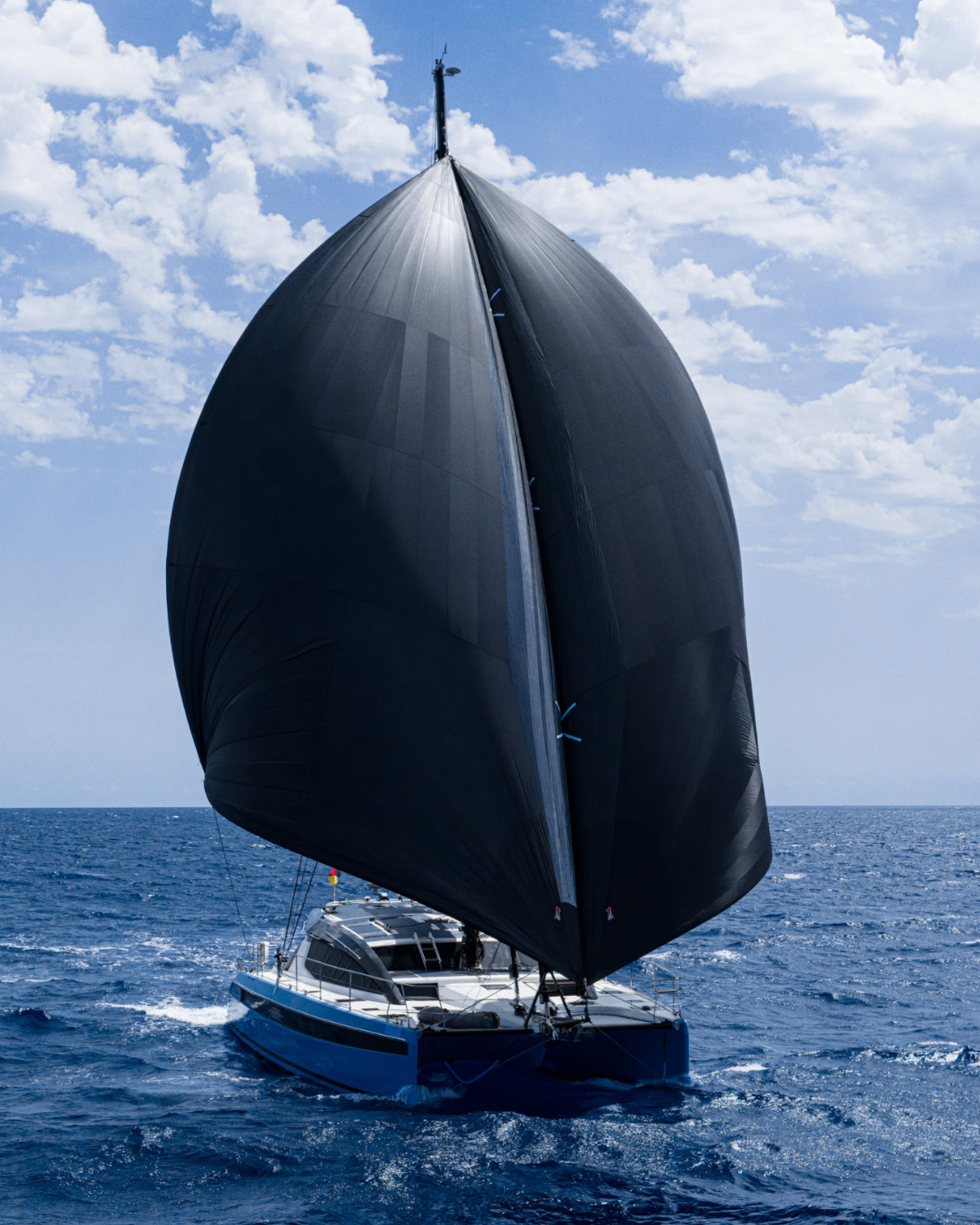
The IFS Multi Tradewind Sail is a refined version of a concept that many sailors have already seen — or even used — during their sailing lives: sailing downwind with two identical, symmetrical sails set wing-on-wing.
What OneSails has done is take that proven idea and significantly improve it through advanced materials, structural design and a completely different approach to handling — creating a sail that is exceptionally easy to manage.
At the heart of the IFS Multi Tradewind Sail is OneSails’ proprietary IFS technology. Its structural luff, built with continuous fibres, eliminates the need for a traditional furling cable and gives the sail a combination of stability, furling efficiency and versatility that makes it remarkably easy to use.
And that ease of use becomes clear as soon as you start sailing with it.
A sail that makes dead-downwind sailing simple
In its fully open configuration — often nicknamed the “Batman Sail” because of its distinctive shape — the IFS Multi Tradewind Sail is designed to sail directly downwind.
A true wind angle of 180° is normally difficult to maintain efficiently with a gennaker or even a spinnaker. Those sails can work at very deep angles, but sailing exactly dead downwind is usually less practical.
The IFS MTWS is different. It works perfectly at 180°, but more importantly, it does not require the helmsman to stay locked onto that exact angle.
There is a generous steering tolerance of at least 15° on either side of dead downwind. In practical terms, this gives the helmsman a working range of roughly 30°. That is more than enough to absorb the normal steering errors of an inexperienced crew or the corrections made by a basic autopilot.
In testing, even wider tolerances have been observed before the windward side of the sail begins to collapse.
The result is simple: you do not need to steer with absolute precision.
Minimal trimming required
The same philosophy applies to sail trim.
Once the correct sheet position has been established for a particular boat, it can be marked directly on the sheets. Before unfurling, both sheets can be set to those marks and locked off.
Release the furler, let the IFS Multi Tradewind Sail open, and it is already very close to its correct trim.
That means less continuous adjustment, fewer mistakes and much less workload for the crew.
For cruising sailors in particular, this is a major advantage. A sail is only truly easy to use when it remains easy after several hours offshore, at night, or when sailing short-handed.
Less work for the autopilot
Another important characteristic of the IFS Multi Tradewind Sail is the way it loads the boat.
When sailing dead downwind, the sail effectively pulls the boat from the bow area, naturally encouraging the yacht to stay aligned with the wind.
Tests on monohulls have shown that the boat can maintain a remarkably stable downwind course even with very little steering input.
This has an immediate consequence: the autopilot has less work to do.
Instead of constantly correcting the heading, it only needs to make relatively small adjustments. That reduces steering activity, power consumption and mechanical load on the system — all important considerations when sailing offshore.
Reduced rolling downwind
For monohulls, there is another major benefit.
Traditional downwind sails, particularly when sailing at very deep angles, can generate significant rolling. As the yacht rolls, its heading changes, which then creates additional work for the rudder, helmsman and autopilot.
The IFS Multi Tradewind Sail behaves differently. Because the central area of the sail is held under control by its structural luffs, the sail produces exceptionally little rolling compared with conventional downwind configurations.
Wave direction and sea state will always influence the motion of the boat, so no sail can eliminate rolling completely. But reducing it significantly makes the yacht more comfortable and, once again, easier to steer.
Less rolling means less rudder movement, less autopilot activity and a more stable boat.
More than one sailing mode
The IFS MTWS is not limited to sailing at 180°.
If you want to sail slightly higher — for example around 165° or 170° true wind angle — the two sides can simply be trimmed asymmetrically. The leeward side is sheeted slightly harder while the windward side is eased.
This shifts the sail’s natural sailing angle without sacrificing its generous steering tolerance.
As the course becomes higher still, the two clews can be connected and the IFS Multi Tradewind Sail can be used as a single, doubled sail.
In this configuration, it covers an exceptionally wide range of wind angles.
The best performance is generally found around reaching angles, but thanks to the adjustable structural luff tension, the sail can be adapted for both deeper and higher courses.
Ease the halyard slightly for lower angles and greater depth in the sail. Increase luff tension when sailing higher to create a more controlled leading edge.
One IFS Multi Tradewind Sail can therefore cover a very broad range of conditions without complicated sail changes.
Easy furling, without a furling cable
Handling is another area where the IFS Multi Tradewind Sail stands out.
Like other OneSails IFS sails, it is cableless. But in the IFS MTWS, the structural element involved in furling is effectively doubled, increasing the torsional efficiency of the system.
This makes furling particularly positive and reliable.
The recommended furling procedure remains good seamanship: reduce apparent wind as much as possible, begin furling with the sail eased, and then increase sheet tension as the head starts to rotate so that the final furl is tight and compact.
However, testing has shown that the IFS Multi Tradewind Sail is remarkably forgiving even when those ideal procedures are not followed perfectly.
In some conditions, particularly when sailing downwind, the sail can simply be furled using the normal furling system without any complicated preparation.
That is an important distinction between a system that merely works and one that is genuinely easy to live with.
A forgiving sail for real-world sailing
The same tolerance can be found when the IFS MTWS is used in its paired configuration.
Ideally, the two clews should be positioned as close together as possible so that the load is shared evenly between both sail surfaces.
But testing has shown that they do not need to be perfectly aligned.
Because the two sail sections are able to move relative to one another along the structural luff, the loads naturally tend to equalise.
Again, absolute precision is not required.
That is a recurring theme with the IFS Multi Tradewind Sail: the system has been designed to tolerate the small inaccuracies that inevitably happen when sailing in the real world.
Simple does not mean careless
There are still a few good practices worth following.
After the sail has been lowered and stored, it is advisable to check the upper part of the furl before hoisting it again. Because there is no furling cable, a loosely stored IFS MTWS can occasionally relax slightly at the head.
If that happens, the first hoist should be carried out with as little apparent wind as possible.
Even in the unlikely event that the upper section partially opens and twists, the situation is comparable to dealing with a twist in a conventional gennaker rather than a serious cable-furling problem. Standard gennaker-handling techniques can normally be used to resolve it.
The clew strops are also designed to simplify switching between the open and paired configurations. They can be sized so that the sheet connections remain accessible from deck level, without changing halyard tension, and colour coding helps ensure that the port and starboard sheets are always reconnected correctly.
So, why is the IFS Multi Tradewind Sail so easy to use?
Because ease of use is not based on one single feature.
It comes from the entire system working together.
The IFS Multi Tradewind Sail gives you a wide steering tolerance when sailing downwind. It requires very little continuous trimming. It naturally stabilises the yacht’s heading, reduces rolling and decreases autopilot workload. It can change from a dead-downwind sail into a versatile reaching sail without a full sail change. And its cableless IFS structural furling system makes deployment and recovery simple and forgiving.
Most importantly, the IFS MTWS does not demand perfect sailing.
You do not need to steer to the exact degree, trim to the exact centimetre or execute every manoeuvre with racing-crew precision.
And that may be the most important innovation of all: not making the sail more complicated, but making a highly capable sail easier to use.