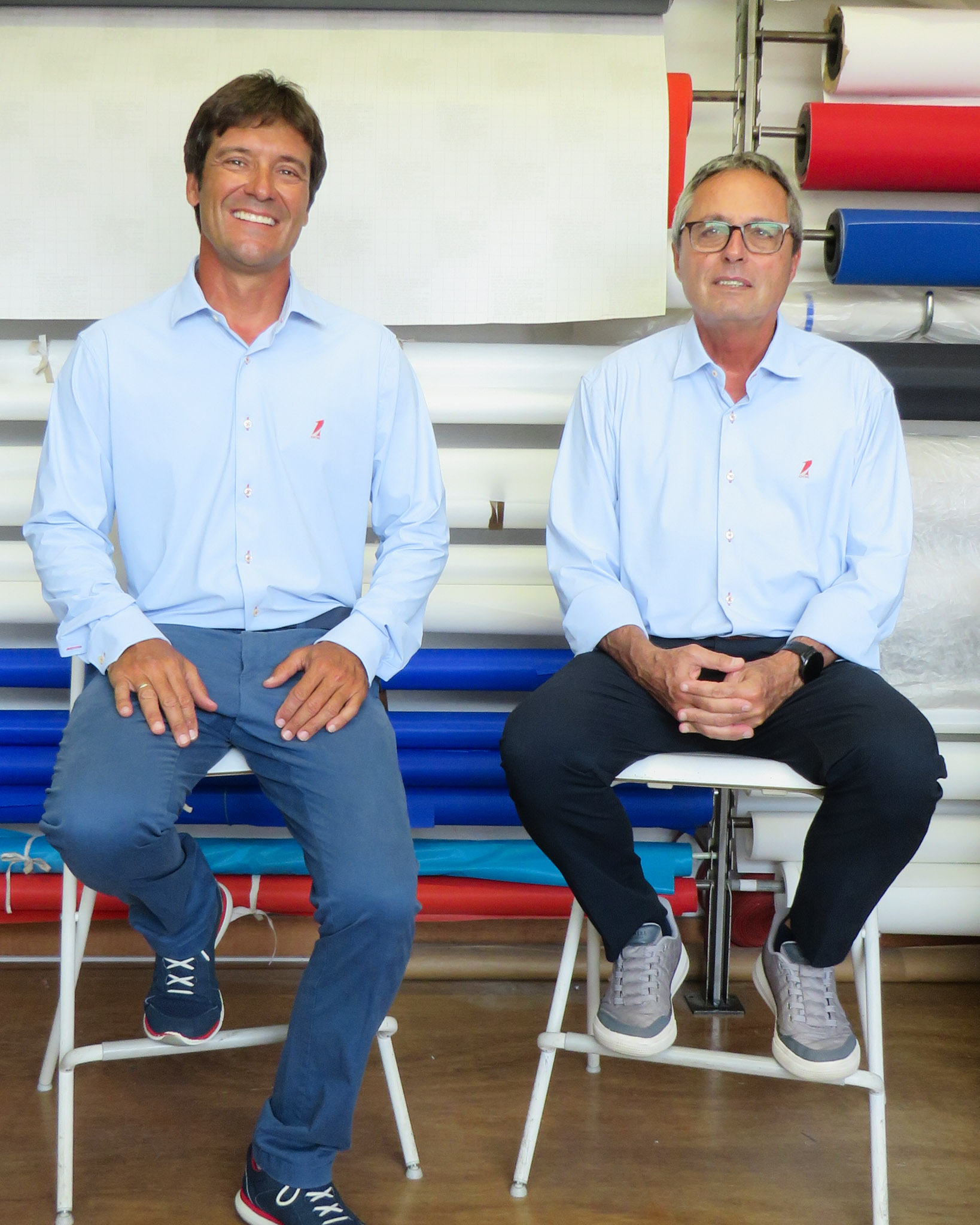


OneSails has launched a new sail development program for the Star class in collaboration with Enrico Chieffi, 1996 Star World Champion in Rio de Janeiro.
The project brings together Enrico’s extensive knowledge of one of sailing’s most technically demanding classes, the long-standing Star-class experience of OneSails North Italy, and the advanced Fluid–Structure Interaction work led by Daniele Ricci, OneSails’ FSI specialist.
The aim is to develop a refined and continuously evolving set of sails that helps Star sailors elevate their performance while contributing new ideas and technical knowledge to the class.
A Long Tradition in the Star Class
OneSails North Italy has a long and successful history of producing sails for the Star class.
Over the years, OneSails sails have contributed to numerous international results. Brazilian sailors Torben Grael and Marcelo Ferreira won the bronze medal at the Sydney 2000 Olympic Games and later claimed gold at the Athens 2004 Olympic Games with OneSails.
Today, that tradition continues through a new development program focused on creating a modern and highly refined generation of Star sails.
The loft’s extensive experience with the class and its deep understanding of the specific technical demands of Star sailing, combined with Enrico’s sensitivity, competitive experience and constant pursuit of improvement, provide a strong foundation for the success of the project.
Combining Experience and Innovation
Enrico now sails mainly for pleasure, but his interest in sail development has continued to grow. He wants not only to improve his own performance, but also to transform his ideas and experience into sails that can be tested and refined on the water.
Enrico’s contribution is based on decades of experience sailing at the highest level. His understanding of balance, shape, handling and performance provides valuable direction throughout the development process.
By combining Enrico’s experience with the technical resources of OneSails, the team is working to produce sails that help sailors improve their performance while also exploring ideas that can contribute to the continued development of the Star class.
The first sails produced through the program have already delivered encouraging results. However, the development process is continuing, driven by the shared pursuit of refinement and performance that characterizes both Enrico and the OneSails team.
Modern Sail Design
Traditionally, designing a sail required a considerable amount of time and repeated physical trials. Much of the process was carried out manually, with designers producing prototypes, testing them on the water and making adjustments based on observations and sailor feedback.
Today, advanced design tools and high-level engineering technologies allow sailmakers to understand how a sail is likely to behave before it is physically constructed.
Designers can simulate its performance under different sailing conditions, analyze how its shape changes under load, determine the most effective orientation of the materials and identify where reinforcements should be positioned.
These tools do not replace the experience of the sailor or sail designer. Instead, they make it possible to study each idea in greater detail, compare different solutions and focus physical testing on the most promising configurations.
Analyzing the Flying Shape
A sail does not retain its static, two-dimensional shape once it is exposed to aerodynamic pressure.
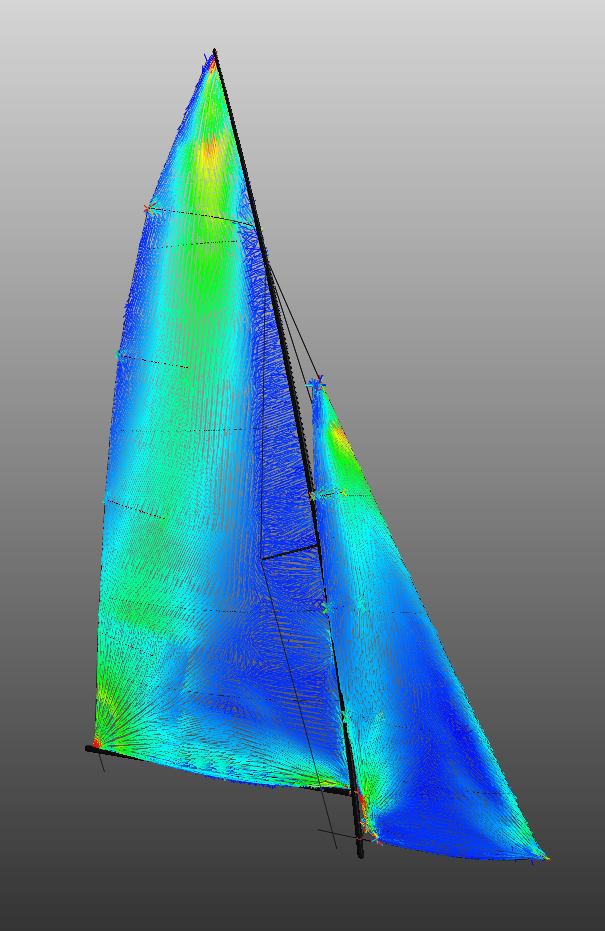
Under load, its materials stretch and its geometry deforms. The resulting three-dimensional form—known as the sail’s flying shape—is what ultimately determines its aerodynamic performance.
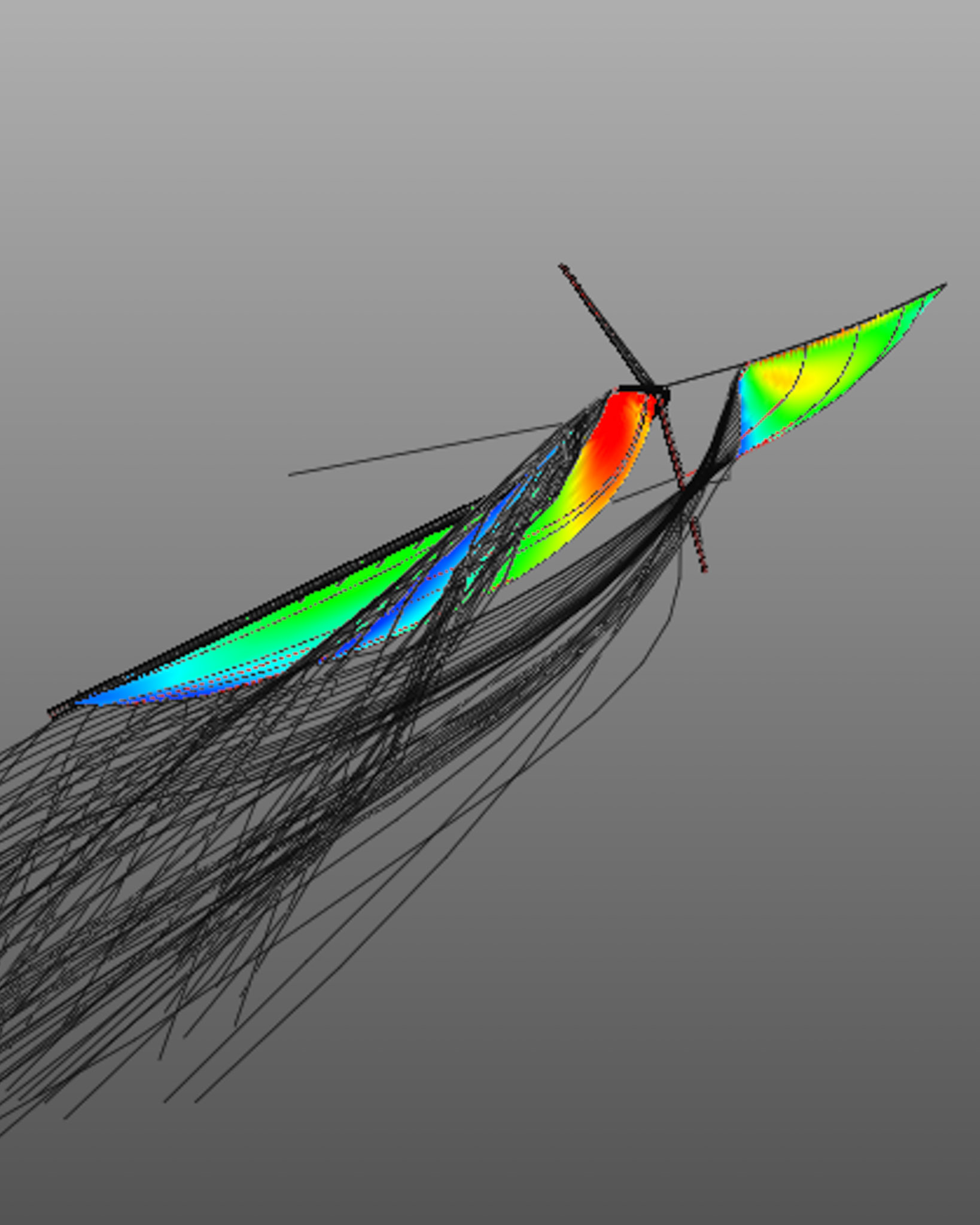
Daniele Ricci, OneSails’ FSI specialist, plays a central role in this phase of the program. Using Fluid–Structure Interaction analysis, Daniele and the OneSails design team can simulate the structural deformation of the sails with a high level of accuracy.
This makes it possible to study how different sections and profiles behave under realistic sailing loads and to compare multiple design solutions before selecting the most effective configurations.
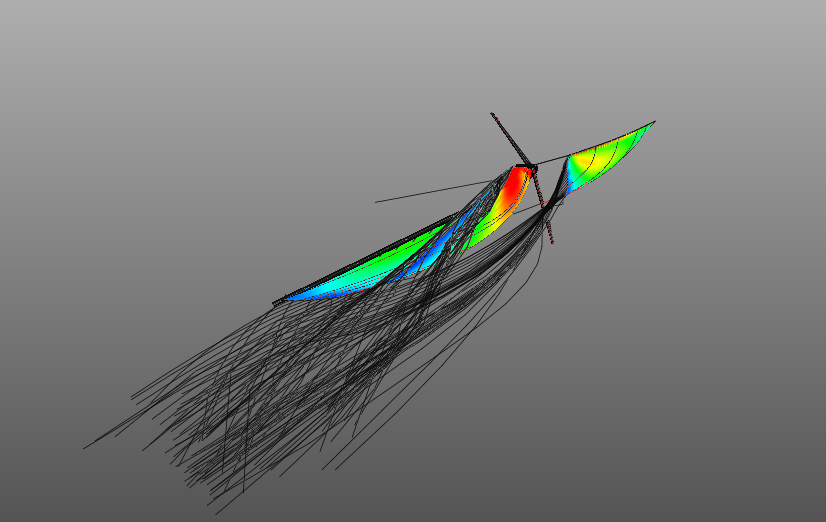
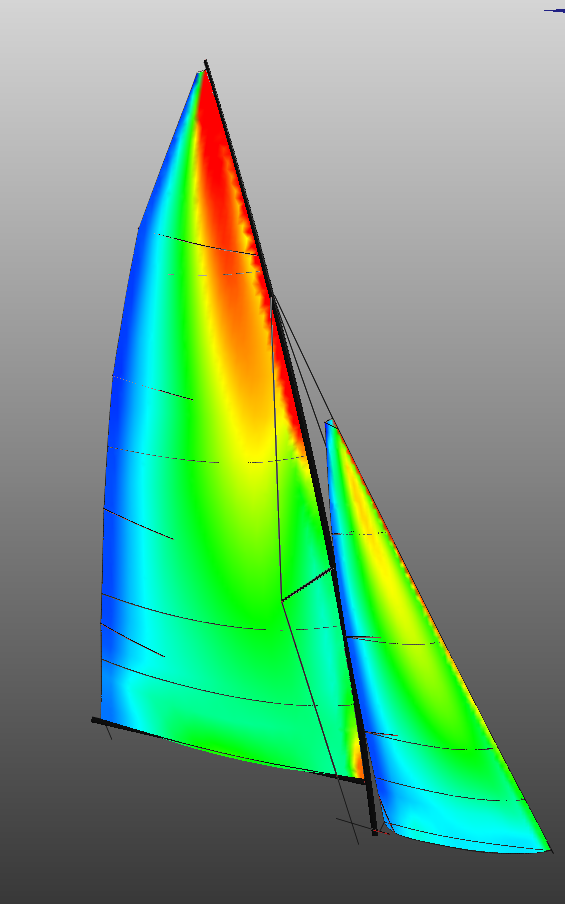
Multiple profile configurations are studied and compared as part of the process, allowing the team to evaluate each solution before moving into production and on-the-water testing.
Faster and More Accurate Development
FSI provides designers with detailed information about how a sail will behave before a physical prototype is produced.
By studying deformation, load distribution, draft position and profile evolution, the team can better understand the relationship between the sail’s designed geometry and its actual shape while sailing.
The orientation of the sailcloth, the position of structural reinforcements and the distribution of loads can all be evaluated during the digital design phase. This enables the development process to progress more efficiently and with greater precision towards the intended performance objectives.
For the new Star sail program, this approach allows OneSails to combine Enrico’s practical knowledge and feedback with the accuracy, consistency and repeatability of a modern digital design workflow.
Development Continues
The first sails created through the program have already shown excellent potential, but the work is not yet complete.
On-the-water testing, Enrico’s feedback and continuous digital analysis are being used to refine each new iteration. Every sailing session provides additional information that can be incorporated into the next stage of development.
“The first sails have been very successful, and I am very happy with them. It is great fun to be involved in this process and to continue developing the sails together.”
The objective is not simply to produce a competitive set of Star sails. It is to build a complete, repeatable and continuously evolving sail package shaped by elite sailing experience, advanced engineering and the specialist knowledge of OneSails North Italy.
By uniting Enrico Chieffi’s experience with the expertise of OneSails, the team is fully immersed in a project designed to help sailors elevate their performance and bring valuable new ideas to the Star class.
For Enrico Chieffi and OneSails, the pursuit of the perfect Star sail continues.