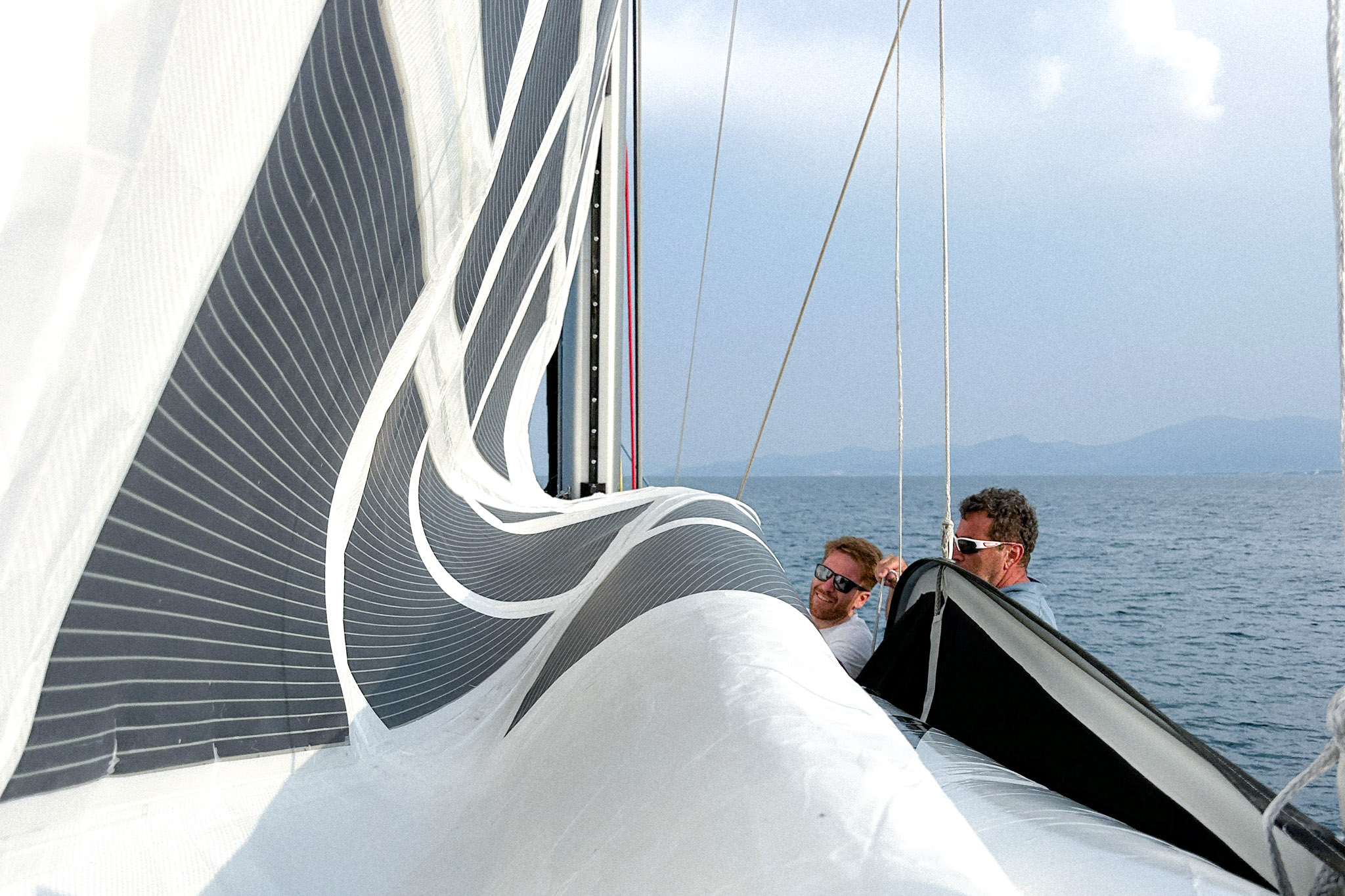
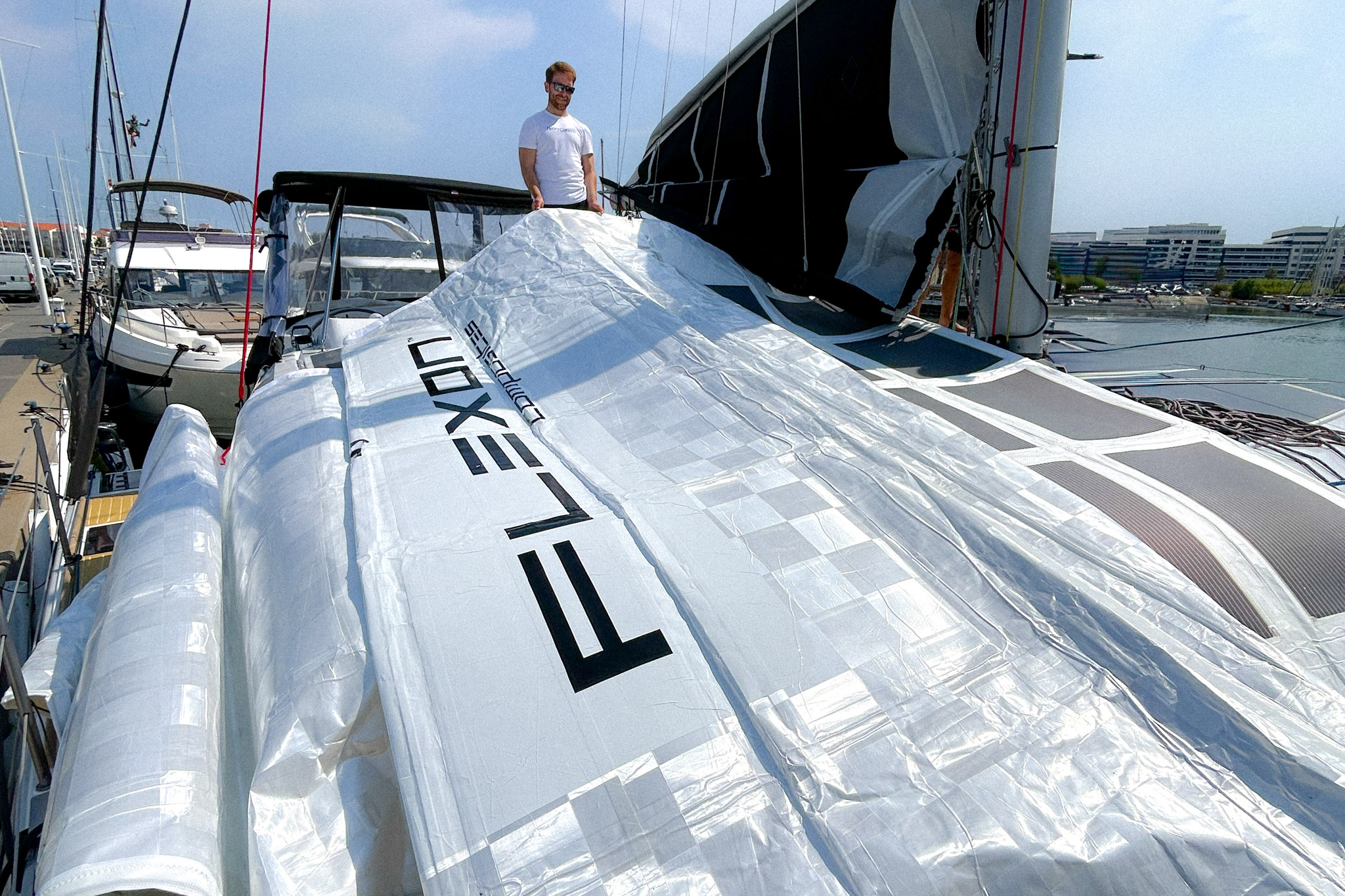
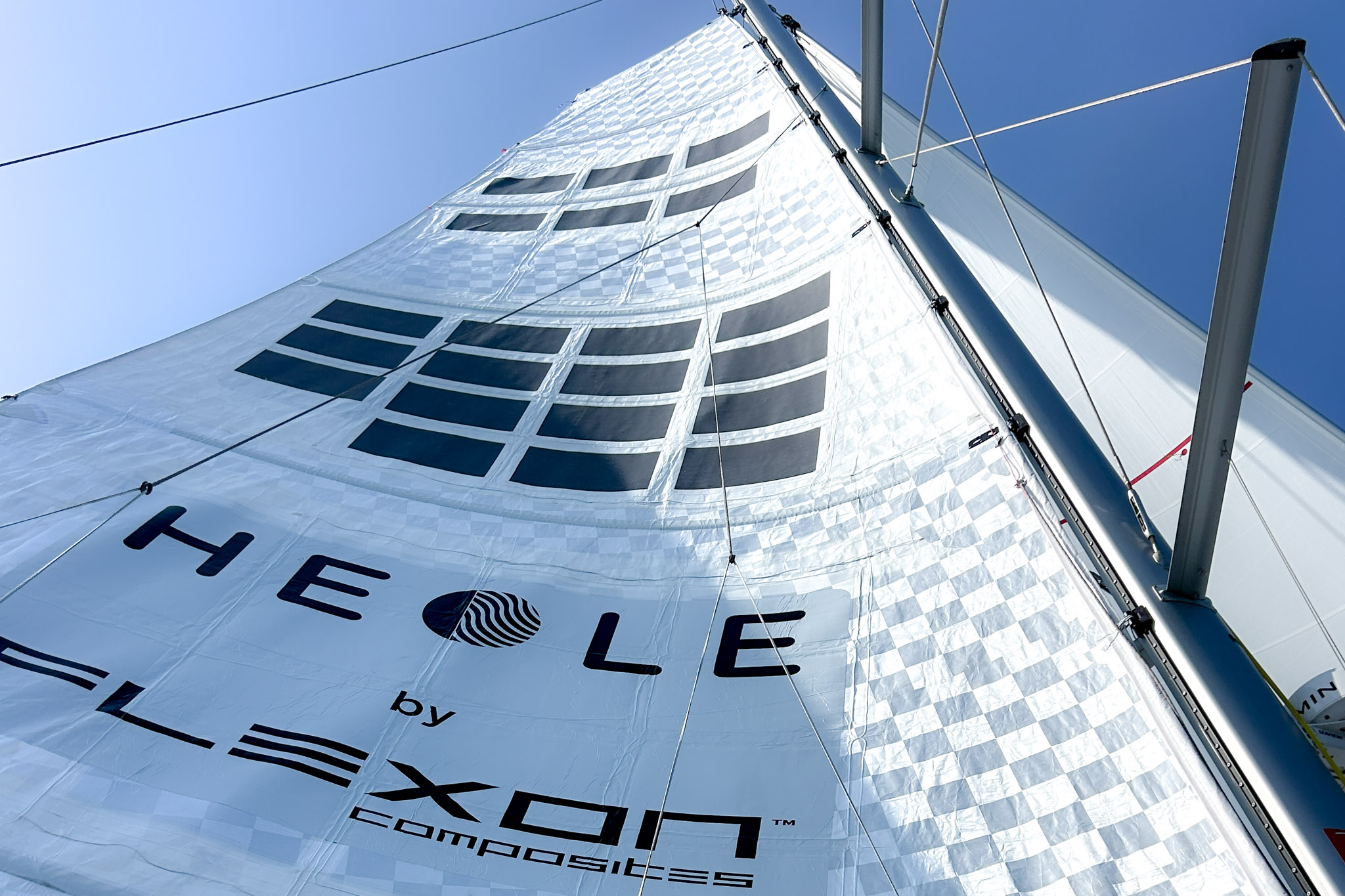
Héole and OneSails have integrated organic photovoltaic (OPV) cells directly into the sail membrane, using lamination expertise from Flexon Composites. The objective is to enable a sailing vessel to generate electrical energy from the sail itself without compromising the flexibility, low weight or handling characteristics required of a high-performance sail.
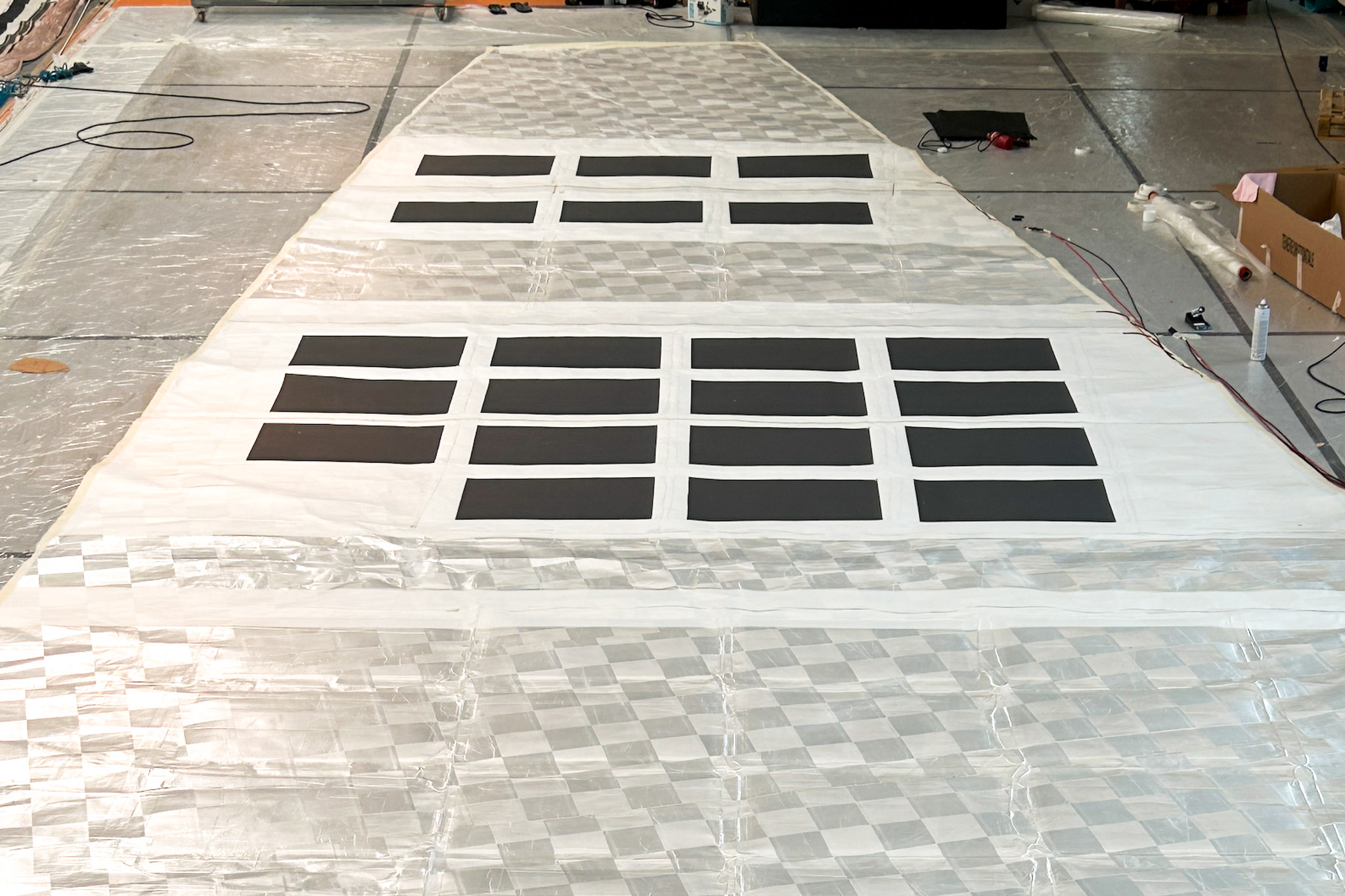
Unlike conventional solar installations mounted on rigid panels, the photovoltaic technology is incorporated into the sail structure during the manufacturing process. The resulting membrane can be folded, rolled and handled like a conventional performance cruising sail, while actively generating power. At approximately 700–850 g/m², a 100 m² mainsail can incorporate 42 panels across 21 m² of active photovoltaic area, producing an estimated 1.5–4 kWh of electricity per day.
The innovation lies in the direct integration of flexible photovoltaic technology into a fully functional sailing membrane, creating a new category at the intersection of sailmaking and solar energy.
Modern sailing yachts increasingly require electrical energy for navigation, communication, instrumentation, refrigeration, lighting and other auxiliary systems.
Conventional photovoltaic systems are normally installed on rigid surfaces such as coachroofs, decks or dedicated structures. These installations can require additional structural support and occupy valuable surface area.
Héole & OneSails addresses this challenge by using the sail itself as an energy-generating surface. The photovoltaic function is integrated into a component that is already present on the vessel, without requiring a separate rigid photovoltaic structure.
We use organic photovoltaic (OPV) technology integrated into the sail membrane.
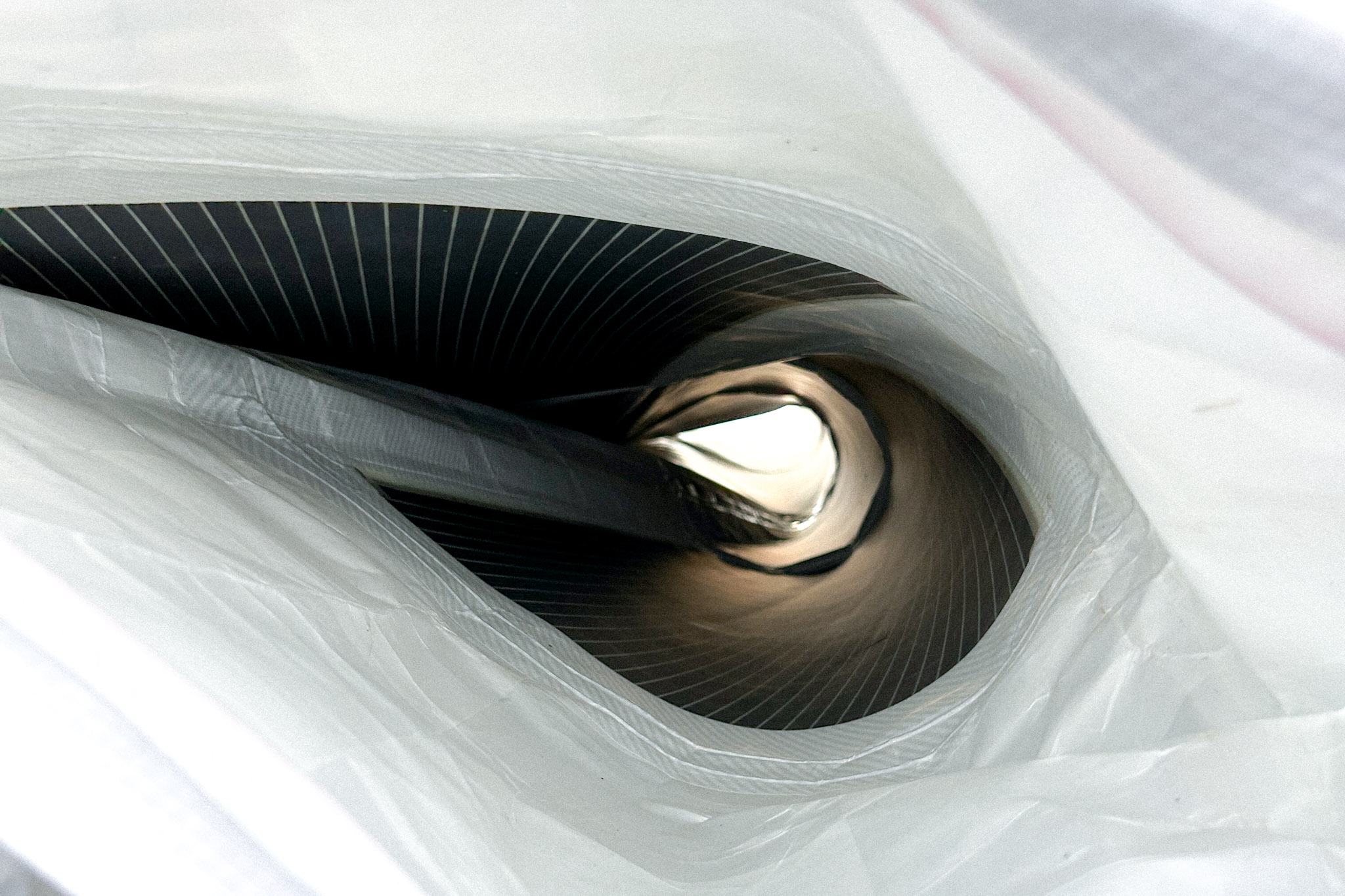
The photovoltaic material is flexible and can be incorporated into a membrane capable of bending, folding and rolling. It can therefore follow the geometry and movements of the sail during normal operation.
The OPV cells can generate electricity from available sunlight, including diffuse and reflected light conditions.
The electrical output is collected through integrated conductive elements and connected to the vessel’s electrical system.
The OPV system generates electricity without direct operational emissions during solar power generation.

The OPV technology is integrated into a multilayer sail membrane.
The structure includes polymeric layers, the photovoltaic active material and thin conductive metallic layers.
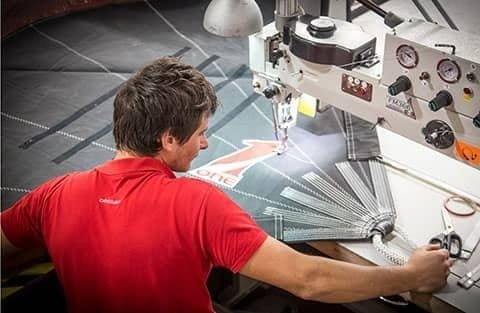
A key element of the construction is the polyethylene (PE) support material in which the OPV elements are integrated, with lamination expertise contributed by Flexon Composites for the structural membrane sail body and the integration of the panels into the sail layering together with the wiring and relative necessary electronics.
The PE support material is covered by documented environmental information (see Environmental Performance, for details).
Compared with conventional rigid silicon photovoltaic panels, OPV technology offers characteristics that are particularly relevant to sail integration:
These characteristics make it possible to use a sail as an active photovoltaic surface without converting it into a rigid panel. Because the photovoltaic surface moves and orients together with the sail, it achieves superior energy efficiency during navigation, maintaining more consistent exposure to sunlight than fixed rigid panels, which are more prone to shading from sails, rigging or vessel heel while underway.
The objective is to preserve the functional characteristics of a high-performance sail while adding an electrical-generation function.

One of the principal engineering challenges was to integrate photovoltaic functionality without compromising the handling characteristics of the sail, so the final product is highly competitive in terms of weight, which means from 700 to 850 g/sqm depending on the amount of OPV panels installed (comparable to a performance cruising sail and quite less than a standard Dacron sail equipping yachts at delivery).
Conventional rigid photovoltaic panels require additional mounting structures and remain rigid during handling.
The system is therefore designed to maintain a sail weight and handling behaviour comparable with the requirements of a conventional high-performance sail, rather than adding a separate rigid photovoltaic installation.
The sail remains capable of being folded and rolled according to normal sailing requirements.
| Integrated Cells | OPV cells laminated into the membrane during its construction, unlike previous attempts where they were attached to the surface of a finished sail. | |
| Folds and Rolls | Handled, folded and stowed with no restriction on use, which rigid panels do not allow. | |
| All Available Light | Generates from direct, diffuse and reflected light. | |
| Conductive Layers | Thin conductive layers collect current within the membrane, with no external connections. | |
| Integrated Wiring | Wiring and electronics built in at lamination. | |
| Marine Components | Selected for prolonged exposure to UV and salt. | |
| No Deck Structure | No frames, no mounting, no separate installation. | |
| Membrane Weight | 700 to 850 g/m², comparable to a performance cruising sail — no added weight over a conventional sail. |

The current OPV technology provides a nominal output of 50 W/m² under Standard Test Conditions (STC).
As an example, on a NEEL 52 trimaran:
The technology roadmap targets further improvements in photovoltaic performance, with an expected increase of approximately 40% by the end of 2027 and approximately 100% by 2030, subject to the evolution of the underlying OPV technology.
These future values are development targets and are not presented as current product performance.
The photovoltaic elements are integrated into the sail during manufacturing rather than attached as a separate rigid component. This approach is intended to ensure that the photovoltaic function is incorporated into the sail’s existing architecture and handling system. The design objective is to achieve durability compatible with the expected service life and operating conditions of the sail.
As with any photovoltaic technology, actual energy yield and service life depend on operating conditions, environmental exposure, installation, use and maintenance.
The environmental approach is based on specific material and technology characteristics rather than on a generic environmental claim.
The OPV manufacturing process operates at relatively low temperatures, approximately 100°C, compared with approximately 1000°C for the production processes associated with conventional silicon photovoltaic technology. These temperatures refer to the respective manufacturing processes and should not be interpreted, by themselves, as a complete lifecycle comparison between OPV and silicon photovoltaic systems.
No rare-earth elements are used in the OPV module. The conductive layers use thin metallic layers such as copper and aluminium. The specific material composition is therefore described in technical terms rather than through a generalised claim such as «free from harmful substances».
The polyethylene support material used in the sail construction is accompanied by documented environmental information prepared in accordance with ISO 14021. The material is produced at an ISO 14001-certified manufacturing site; this certification relates to the site’s environmental management system, not to an environmental certification of the material itself or of the complete sail. Where applicable, environmental performance information relating to the material is based on the methodological approach of ISO 14067 for product carbon footprint assessment. These statements are limited to the material and the documented production processes to which they refer.
Published reference values for photovoltaic technologies indicate carbon-intensity ranges that can vary significantly according to technology, manufacturing location, electricity mix, system boundaries, lifetime and methodology. For this reason, a generic technology-level carbon figure is not presented as a product-specific carbon footprint for the complete sail.
Reference values of approximately 3–15 g CO₂e/kWh for OPV and 15–70 g CO₂e/kWh for silicon photovoltaic technology may be used only as technology-level reference ranges where their original methodology and system boundaries are clearly identified. A product-specific carbon footprint claim would require an assessment covering the defined product system, materials, manufacturing processes, expected lifetime and energy production according to an appropriate methodology.
Durante más de 15 años, el equipo de diseño de OneSails ha desarrollado tecnologías exclusivas para hacer realidad las velas de hilo continuo de una sola pieza para embarcaciones de crucero y regata.
Características como el peso, el control de la forma y la resistencia a la deformación significan un mejor rendimiento en comparación con las velas tradicionales de paneles.
Las velas están diseñadas y fabricadas con los más altos estándares utilizando componentes cuidadosamente seleccionados para garantizar la más alta calidad y durabilidad. Las membranas 4T FORTE™ se fabrican exclusivamente en Italia. Todo el proceso de ensamblaje se realiza completamente en una única fábrica, asegurando que se cumplan todos los estándares requeridos.
Las mejores formas de vela son el resultado de un análisis continuo y de la experiencia. OneSails está a la vanguardia de la industria de la fabricación de velas, invirtiendo continuamente en investigación y desarrollo para garantizar que las mejores formas de vela estén disponibles. El éxito de este enfoque se confirma con la gran cantidad de trofeos de regatas que los clientes de OneSails han ganado, compitiendo a nivel nacional, internacional y en campeonatos mundiales.
Una actividad clave para cada Loft de OneSails es ofrecer un servicio, apoyo y asistencia de primera clase. Como parte de nuestro compromiso con el servicio, cada Loft de OneSails cuenta con un equipo de expertos disponible para garantizar que cumplamos con nuestra promesa de servicio. Además de un número creciente de lofts principales, el Grupo OneSails tiene una extensa red de centros de servicio estratégicamente ubicados a lo largo de las costas del mundo.